Marks, Glazes and Gut Instinct: Field Notes from a Macclesfield Pottery Hunt
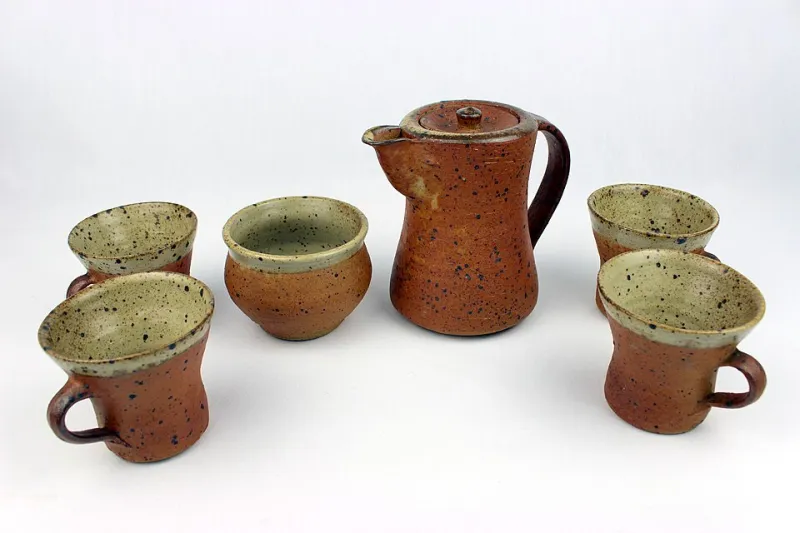
Photo: Bernard Leach, CC BY-SA 3.0, via Wikimedia Commons
There is a particular kind of pot that turns up in Macclesfield with reassuring regularity. It sits slightly apart from the rest of the shelf, looks a bit serious, and costs about the same as a round of drinks. Nobody in the shop knows what it is. Half the time, neither does the person who donated it.
That's the gap worth hunting in.
British studio pottery — the hand-thrown, small-workshop end of the ceramics world — has never been cheaper to collect than it is right now. The big names still command money, but the wider field is wide open, and Cheshire's charity shops, church halls and antiques centres are quietly full of it. You just have to know what you're looking at.
Start with the back of the pot
Turn it over. Always turn it over. The base is where a potter signs their work, and it's the first thing an experienced eye checks before anything else.
What you're looking for comes in a few flavours:
- Impressed seals. A stamped monogram or device pressed into the clay while soft. Often small, often faint, frequently mistaken for a manufacturing flaw by whoever priced it.
- Incised initials. Scratched in with a tool, sometimes just two letters and a date. Easy to miss against a dark glaze.
- Painted marks. Brushed on in oxide or slip under the glaze. These survive well but blur slightly.
- Paper labels. Old gallery or exhibition stickers. Not a maker's mark, but a lovely bit of provenance and worth leaving in place.
A mark on its own doesn't mean value. An unsigned pot with a superb glaze is worth more to me than a signed one with a lumpy rim. But a mark tells you someone committed to the piece, and that's a useful starting signal.
Glazes that repay a second look
Glaze is where studio pottery separates itself from factory ware, and where most bargains are won or lost.
Get to know a handful of families. Tenmoku — deep brown-black, breaking to rust at the edges. Celadon — soft green, the colour of a shallow river. Oatmeal — speckled buff with a dry, toasted surface. Chun-style blues, ash glazes with runs and pooling, salt-glazed stoneware with its faint orange-peel texture, and the flat matte dolomite finishes that were everywhere in the 1970s.
What you're really judging is depth. A good glaze has variation — thinner at the rim, pooled in the throwing rings, breaking over a ridge. A cheap glaze is even, flat and slightly dead. Hold the pot up to a window and see whether the surface does anything.
Forms that earn their shelf space
Studio potters worked in a fairly small vocabulary of shapes, and most of them are still good shapes: the bottle vase, the teabowl, the lidded jar, the jug with a pulled handle, the wide shallow dish.
Watch the details. A handle that was pulled by hand rather than cast has a taper and a slight irregularity that reads instantly. A lid should sit with a small, satisfying click rather than rattle. Foot rings should be trimmed cleanly, not left with a rough edge. A pot with a confident profile will usually have been made by someone who cared.
The condition traps
This is where enthusiasm costs money. A few things to check before you part with your fiver:
Chips and nibbles. A small chip on a rim — a 'flea bite' — is survivable on a rare piece and fatal on a common one. Be honest with yourself about which you have.
Crazing versus crackle. Crazing is a fine network of cracks in the glaze, usually harmless. A crackle glaze is intentional and was designed that way. A crack in the body of the pot is neither, and it will not get better.
Drilled bases. A lot of vases came back from the 1980s with a hole punched through the foot to take a lamp fitting. Sad, common, and permanent.
Dishwasher damage. Dull, etched glaze with a slightly gritty feel. No amount of polishing brings it back.
Old repairs. Look along the rim and handle with a torch angled across the surface. Restoration hides well in a bad light, but it never quite matches under raking light.
Where to look in and around Macclesfield
Start with the charity shops in town — the ones on the main drags get the house clearances and the ones tucked down side streets get overlooked. Church hall sales in the villages are gold, particularly in the autumn when people clear out before winter. The town's monthly makers' market is worth a wander too, though you'll pay artisan prices there rather than charity-shop ones.
Then widen the circle: the antiques centres between Macclesfield and Congleton, the salerooms on the edge of town, and any general auction that lists 'ceramics and glass' in a job lot. Boxes are where the finds are. You'll buy a lot of forgettable stoneware to get one stunning bowl, and that's fine — the forgettable ones go back to the charity shop.
The five-pound rule
Here's my rule, and it's served me well: if a pot is under a tenner and you'd happily put it on your own shelf, buy it. Research it later. The downside is a fiver. The upside is a lifetime of looking at something lovely and remembering the afternoon you spotted it while everyone else was browsing the DVDs.
Macclesfield is unusually good for this. Silk money built the town, and good pots have been flowing in and out of Cheshire households for a century. Some of them are sitting on a shelf on Mill Street right now, priced to move, waiting for someone to pick one up and turn it over.