Five Shopfront Clues That Unlock Macclesfield's Retail Past
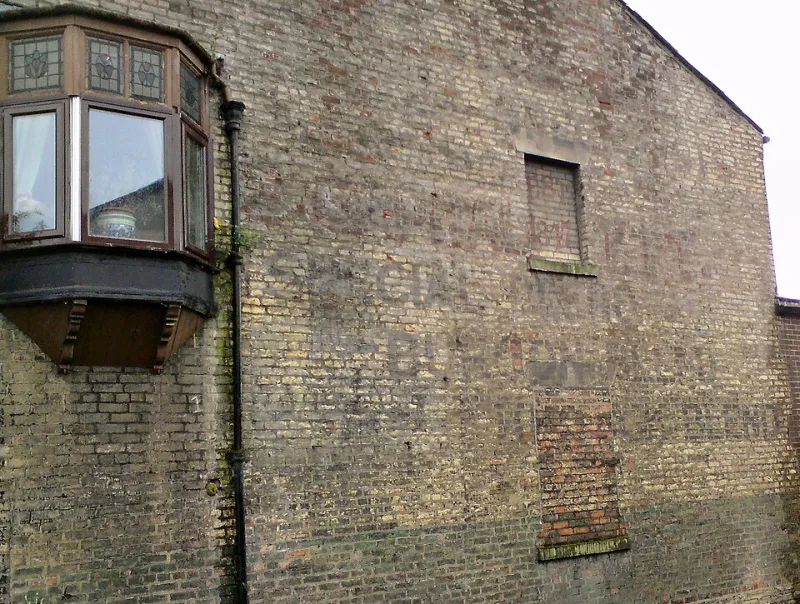
Photo: Gerald England , CC BY-SA 2.0, via Wikimedia Commons
Shopfronts are the part of a town that gets rewritten most often. A new tenant paints over the old name, a new fascia hides the old brackets, a new door goes in and the step stays put. Macclesfield is full of these small survivals. You do not need an archive appointment to read them. You need a dry Saturday, a bit of patience and the habit of looking up and down as well as straight ahead.
This is not a formal heritage trail. Think of it as a shopping guide for the curious: five clues that turn a walk through town into a retail story, and a few notes on buying the oddments that fall out of those old shops when they close.
Clue one: the ghost sign
A ghost sign is the faded painted lettering on a wall or above a shopfront. Sometimes it is the old name of the business; sometimes it is a product advert. Look for lettering that does not match the current fascia: 'grocer', 'draper', 'ironmonger', 'provisions'. The best ones are on side walls and upper floors, where later shopkeepers could not be bothered to paint over them.
Genuine ghost signs have depth. The paint sits in the render, the edges are soft, and later layers show through in patches. Modern pastiche signs are usually too crisp, too evenly faded and too fond of curly fonts. If a sign looks like it was designed for Instagram, it probably was.
Clue two: the tiled threshold
Look down at the doorway. Victorian and Edwardian shops often had encaustic or geometric tiles at the entrance, sometimes with the shop name or a motto set into the pattern. A tiled threshold is a small act of pride: cheap to clean, hard-wearing, and a signal that the shop expected people to stop and look.
Wear tells you where the door swung and where customers stood. A threshold worn in the middle and smooth at the edges has seen a lot of footfall. If the tiles are cracked but complete, that is often better than a perfect modern replica. When old shop tiles are lifted and sold on, they turn up in antiques centres as garden edging, hearth strips and splashbacks. Buy them for the pattern, but check the edges for old cement and honest wear.
Clue three: shutter rails and bell boxes
Ironmongery is the skeleton of a shopfront. Look for the rails that once carried shutters, the brackets for a blind, the holes where a hanging sign was fixed. A bell box above the door — a small metal or wooden box that once rang inside when the door opened — is a lovely thing to find still in place.
These fittings are often the last things to go because they are awkward to remove. They can also be the first things to be stolen or replaced. If you are buying old shop ironmongery, look for consistent wear, old screws and a maker's name. A brass bell box with a worn pull and a good patina is a better buy than a shiny reproduction with fake age.
Clue four: old display fittings
Inside the shop, or in the window, old display fittings tell you what was sold and how. Brass rails, glass shelves, adjustable brackets, drawer units, a counter with a worn edge: these are the working furniture of retail. A draper's shop needed long runs of shelving; an ironmonger needed bins and drawers; a grocer needed scales and a counter.
When these fittings are sold on, they often arrive in antiques centres without much context. A set of mahogany drawers may have started life as a seed cabinet. A glass display case may have held cigarettes or haberdashery. Ask what the seller knows, but do not expect a full provenance. Look at the construction: drawer runners, dovetails, old screw holes and the pattern of wear will tell you more than a label.
Clue five: the step and the stall riser
The humble shop step is a useful clue. A high step suggests an older building with a raised floor; a shallow step suggests a later refit. The stall riser — the solid panel below a shop window — can hide old tiling, brickwork or painted lettering. Sometimes a later fascia has been fixed straight over the original, leaving a ghostly outline when it is removed.
For collectors, the step is not for sale, but the principle is. Shopfronts were built in layers. So were the objects that came out of them. An old shop sign, a set of brass hooks, a tiled panel or a wooden drawer can all carry the memory of a particular trade. The provenance is not just the maker's name; it is the wear pattern.
How to spot genuine old shop fittings
First, ignore the styling and look at the wear. Genuine shop fittings have wear where hands and goods touched them: counter edges, drawer pulls, shelf fronts. Reproduction pieces often have uniform colour and sharp edges. Second, look at the back. Old fittings usually have old screw holes, ghost marks from removed brackets and a mixture of timbers. Third, check the joints. A Victorian drawer unit will have hand-cut dovetails or machine dovetails consistent with its date; a modern copy may have dowels and a sprayed finish.
Ask about provenance, but treat it as a bonus, not a guarantee. A dealer who says 'it came from a shop in Macclesfield' may be repeating a story. That does not make the object bad; it just means you should judge it on its own merits.
A Saturday route for the curious
Start around Market Place and Chestergate, where the older retail frontages are thickest. Walk up Mill Street and Jordangate, then loop towards Sunderland Street. Look up for ghost signs, down for tiled thresholds and sideways for shutter rails. Pop into the antiques centres and charity shops when the weather turns. The point is not to complete a trail; it is to slow down enough to notice.
Macclesfield's shopfronts are not a museum. They are a working town with a long memory. The next time you see a faded sign or a worn threshold, read it as a receipt. Somebody sold something there, and somebody bought it. In 2026, the best souvenir may be a small piece of that retail past — a brass hook, a tiled panel, a drawer that still smells faintly of tobacco and tea.